Mortgage valuation in Amsterdam for expats: align the lender application
Prepare an expat mortgage valuation in Amsterdam by aligning the property, lender, income currency, residency and report requirements before the inspection.

TL;DR: Keep property and income questions separate
An expat mortgage valuation works best when the property question is fixed first and the international parts of the financing application are then attached to it. Name the home, purpose, valuation date and recipient. Ask the lender which report and validation it accepts. Record currency and residency facts for the lender or adviser, gather property records, arrange the inspection and compare the completed report with the written instruction. Keep these numbers separate: the property’s market-value figure, the purchase price, the 100% home-value ceiling, the 2026 NHG limit, the 90% qualifying non-resident threshold and the lender’s income assessment. A number can be useful in one part of the application and irrelevant in another.
- Ask the lender for the report, validation, recipient, date and delivery requirements.
- Write the property purpose and valuation date in one sentence.
- Record currency, residency and tax questions for the lender, adviser or Tax Administration.
- Collect property, leasehold, VvE, permit and renovation evidence and arrange the inspection.
- Match the finished report to the instruction before it enters the mortgage application. The 100% home-value ceiling describes the property-value part of a mortgage, while income and other obligations remain separate questions.
Are you arranging an Amsterdam mortgage from abroad?
You are arranging an Amsterdam mortgage across borders, with property records, income currency and residency facts that may come from different systems. Keep those details in their proper places so the valuation answers the property question and the lender can assess the financing on its own terms.
- buying an Amsterdam home while living in another country;
- paid by a foreign employer or paid partly in a foreign currency;
- moving to the Netherlands and arranging a mortgage before registration or after a recent move;
- unsure whether the lender wants an ordinary valuation, a validated report or a named recipient; or
- trying to keep tax-status, translation and property questions in one clear set of records. Have the property address, purchase terms, intended use, lender or adviser, preferred valuation date and finance deadline available. You can add the income currency and residency facts without sending personal documents to a general information site.
An expat borrower can compare the address, property type and valuation purpose with an Eindhoven-area property valuation comparison before the lender finalises the mortgage brief.
Before you arrange the valuation
Make four short headings in the application: property, lender, income and residency. Under property, record the address, dwelling type, ownership, leasehold position, usable area, condition and planned works. Under lender, record the accepted report type, validation requirement, report age, recipient and deadline. Under income, name the currency, employer or business structure and the person who will confirm affordability. Under residency, record where you live, where income is taxed and whether a tax adviser has already assessed your status. A short label is enough. Do not place a passport, payslip, tax return or bank statement in a public contact form. The Amsterdam mortgage valuation brief should name the property, purpose, valuation date and intended report user before international evidence is added.
Why an international application needs separate questions
The value opinion concerns the property at a stated date. It may consider location, rights, condition, use and relevant market evidence. It does not certify that the buyer meets a lender’s income test. It does not establish tax residency. It does not guarantee that a translated document or a report format will be accepted.
The buyer’s lender or mortgage adviser brings the income, debts, currency exposure, product rules and application deadline into the decision.
A tax adviser or the Tax Administration deals with the tax category and deductions.
The valuer needs enough property information to answer the valuation purpose without guessing about facts that belong elsewhere.
The 90% income test for a qualifying non-resident taxpayer belongs to the tax-status question, not to the property’s market-value opinion.
The Tax Administration describes the category for people who live outside the Netherlands in an eligible country and pay Dutch tax on at least 90% of their total income.
Whether that category fits a personal situation requires the relevant facts.
For a qualifying non-resident, the 30-year mortgage-interest period is tied to the mortgage date and repayment conditions described by the Tax Administration.
That time period gives context for a tax question.
It does not change the valuation date or the market evidence in the property report.
Requirements and constraints
Place these fields in the brief:
- Property: address, dwelling type, rights, ownership, usable area, condition and planned works.
- Purpose: purchase finance, refinancing, transfer, renovation finance or another named decision.
- Dates: valuation date, inspection date, report delivery date and lender deadline.
- Recipient: lender, validator, adviser or another named user.
- International facts: residence country, income currencies and the person responsible for the income and tax questions.
- Documents: purchase agreement, deed, leasehold terms, VvE records, permits, plans and relevant building information.
- Language: original document, issuing body, date and any translation or acceptance requirement.
The recipient should be able to match the report fields for this valuation to the address, rights, date, assumptions and supporting evidence.
The 2026 NHG limit is €470,000, or €498,200 with the stated energy-saving provisions, subject to the rest of the conditions.
Treat those as published thresholds, not as a personal approval.
The lender still assesses the property, income, loan and records.
The NHG treatment of foreign-currency income keeps the loan in euros and leaves the lender to assess whether the income and risk controls are appropriate.
Put the currency in the brief so the lender can state the evidence it needs.
A conversion made for a rough calculation is not the same as a lender’s accepted income assessment.
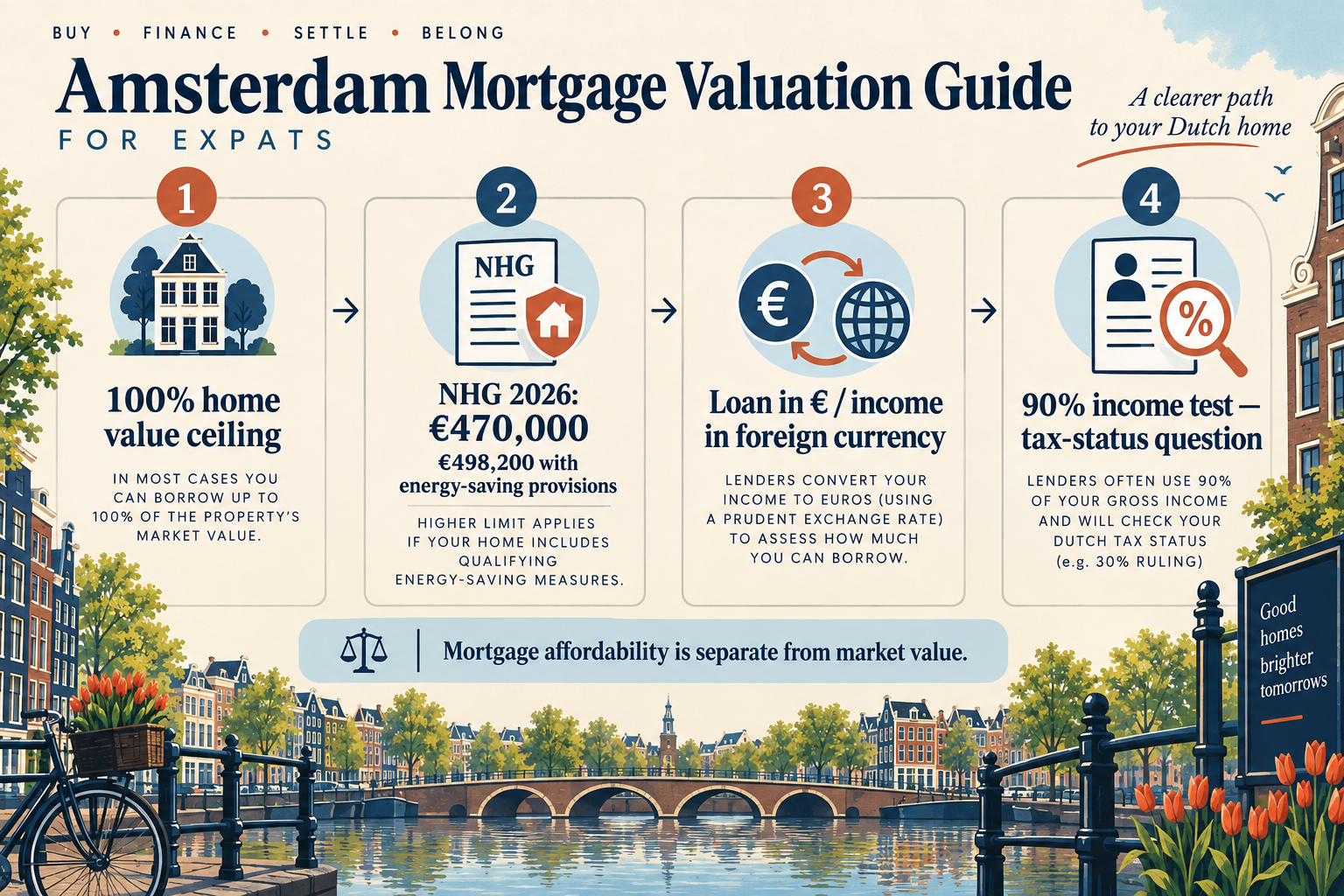
The infographic presents four separate checks. The 100% figure concerns the home’s value, the €470,000 and €498,200 figures are 2026 NHG limits with different conditions, the currency panel belongs to the lender’s income assessment and the 90% figure belongs to the qualifying non-resident tax category.
When you compare quotes, relate the valuation costs in Amsterdam to the scope, inspection, delivery conditions and follow-up you need.
A sound valuation report keeps the property, purpose, valuation date and recipient visible, so you can test whether the conclusion fits your decision.
Step by step: prepare an expat mortgage valuation
1. Put the lender’s instruction in writing
Ask which report form, validation path, report age, recipient and delivery date apply. Keep the reply with the property address. A lender’s use of the word “valuation” can cover a particular report product, so the accepted form matters more than a generic label.
2. State one property question
Write: “Please value [address] for [purpose] as at [date], for [recipient].” Add whether the property is an apartment, leasehold home, mixed-use building or renovation project. If the lender wants a value before or after a planned improvement, state the assumptions beside the date.
3. Separate the international evidence
Create a small list of residence country, income currency, employer or business structure and the person who will answer the affordability question. Mark each item as information for the lender, adviser, tax professional or valuer. This keeps a foreign payslip from being mistaken for property evidence.
4. Collect property records
Add the purchase agreement, title or leasehold information, VvE budget and minutes where relevant, permits, plans, invoices and known defects. Record the original language and date of each document. Ask the recipient whether a translation, sworn translation or particular report format is needed before the inspection.
5. Arrange the inspection and delivery
Confirm access, the person who will attend, the agreed scope and the date the report is needed. A complete set of property records can still miss the financing deadline if the inspection and recipient review are planned separately.
6. Match the report to the brief
Compare address, purpose, valuation date, property description, market-value figure, assumptions, limitations and recipient. Then compare the delivery date and report format with the lender’s written instruction. An open point belongs with the person who can answer it before submission.
Scenarios and variations
The purchase price and market value differ
Suppose a purchase agreement states €600,000 and an illustrative valuation figure is €575,000:
€600,000 - €575,000 = €25,000
The €25,000 is a price-to-value gap in this illustration. It is not an approved loan amount, a tax result or a conclusion about why the difference exists. The lender decides how the gap fits with income, other obligations, product conditions and available funds.
Income is paid in a foreign currency
Write the payment currency and the date of every exchange-rate calculation in the lender application. The NHG treatment of foreign-currency income states that an NHG loan remains in euros and that foreign-currency income can be considered when appropriate and responsible, with currency-risk measures where needed. A lender outside that exact context may have its own evidence and conversion conditions.
The buyer may qualify as a non-resident taxpayer
The 90% threshold is a tax-status fact. It is not a shortcut through the mortgage assessment. Keep residence, Dutch-taxed income and total income records with the tax question, while the property address and market-value valuation brief stay in the valuation brief.
The buyer is moving before the mortgage starts
A new address, employment contract or residence status can affect the lender application without changing the home’s physical condition. Record the valuation date and the application date separately. Ask the lender which facts must be current on the report date and which must be current at submission.
The property is an apartment or leasehold home
For an apartment, add the deed of division, VvE budget, minutes, reserve-fund information and large maintenance decisions. For leasehold, add the terms, canon information and relevant dates. International ownership or income facts do not replace these property records.
Common mistakes and stalled preparations
- Treating a translated payslip as property evidence: label it as income evidence and give it to the lender or adviser.
- Converting income without a date: record the currency, conversion date and method so the lender can apply its own rule.
- Calling the 90% threshold a mortgage rule: keep tax status and affordability in separate questions.
- Assuming 100% means every cost is financed: the home-value ceiling does not answer income, costs or other obligations.
- Quoting €470,000 as an approval: the NHG amount is a published limit with associated conditions.
- Ordering the wrong report: obtain the recipient, validation, report-age and delivery wording in writing.
- Sending sensitive documents through a general form: ask about document categories without attaching identity, bank or tax records.
- Letting a changed residence or employer go unrecorded: tell the lender or adviser when a material fact changes. When the preparation stalls, write the missing fact, its owner and the date needed. The valuer can answer a property or market-value question. The lender or adviser can answer an income, currency or report-acceptance question. A tax professional can answer the personal tax question.
If you still have a question about the property, purpose or date, contact Taxateur Amsterdam with the question and without personal attachments.
After the report: review and repeat
Keep the written lender instruction, property records, inspection details and completed report together. Before delivery, compare the address, purpose, valuation date, report recipient, market-value figure, assumptions, limitations, validation and report format. Repeat that comparison when the purchase price changes, the lender changes, the valuation date moves, the property is altered, the buyer changes employer or currency, the residence country changes or a different recipient is added. A fresh fact can change the valuation purpose even when the address remains the same.
FAQ
Does a valuation tell an expat how much they can borrow?
No. It provides a property and market-value opinion for a stated purpose and date. The lender or adviser assesses income, debts, currency, product terms and available funds.
Does the 100% figure guarantee full financing?
No. It describes a property-value ceiling. Income, interest conditions, other obligations, lender rules and costs can produce a different result.
Is €470,000 the maximum mortgage for every expat?
No. It is the published 2026 NHG limit for the stated NHG context, with €498,200 available in the energy-saving case described by NHG. Eligibility and lender acceptance depend on the rest of the conditions.
Can foreign-currency income be used?
It can be considered in the NHG context when the lender considers it appropriate and responsible and addresses currency risk. The loan itself remains in euros under the NHG wording. The lender confirms the evidence and method for the particular application.
Does living abroad automatically give a tax deduction?
No. The qualifying non-resident category has residence, Dutch-taxed-income and other conditions. A tax professional or the Tax Administration can address the personal facts.
Will a translated report always be accepted?
No. The recipient decides which report, validation, language, translation and delivery format it accepts. Put that requirement in writing before the inspection.
When to recheck the figures
NHG limits, lender procedures and Tax Administration guidance can change. Recheck the published amount, the 90% tax-status condition, the foreign-currency wording and the 30-year period when a new application starts or a material fact changes. Keep the source date beside any figure carried into your personal records. An international valuation brief is easiest to explain when the Dutch property question, the English summary, the purpose, the date and the recipient stay together. Personal affordability and tax consequences still belong with the qualified professional responsible for those decisions.
An international application can stall when a lender's report request, a foreign-currency payslip and a residency question sit in different places. Put the property, purpose, valuation date and intended report user together first. General questions about the valuation purpose or documents can be sent through the contact form; do not attach passports, payslips or other sensitive records.
Ask a question about an expat mortgage valuation