Mortgage valuation in Amsterdam for investors: separate property, rent and finance
Investing in Amsterdam property? Prepare the valuation with property facts, rent evidence, lease terms, VvE records and the lender's investment criteria in one clear set of records.

TL;DR: Five checks before you rely on rent
An investor mortgage valuation in Amsterdam should start with the lender’s purpose and the property’s legal and physical facts. Assemble the lease and rent evidence, test the arithmetic as an illustration, check WWS and rental constraints, gather VvE and permit records, arrange the inspection and reconcile the finished report with the recipient’s requirements. Keep five figures separate: purchase price, market value, gross rent, net operating income and the amount the lender may consider. The 100% home-value mortgage ceiling describes one property-value ceiling; an investment lender can apply different product and borrower conditions.
- Ask the lender for purpose, report form, valuation date, validation and delivery requirements.
- Establish the property’s ownership, rights, condition, use and planned changes.
- Verify the lease, rent, WWS inputs, contract date, VvE records and relevant permissions.
- Reconcile rent and cost arithmetic without treating yield as market value or a promised return.
- Commission the valuation, inspect the report and resolve open points before submission.
If your Amsterdam decision also involves mortgage valuation for Amsterdam movers, keep its lender requirements separate from the property question here.
The apartment is part of a building and the building’s financial and maintenance position may matter. VvE decisions, reserve funds, service charges, planned works and rights in the deed belong in the application. A major repair or weak reserve can alter the questions around condition, timing and costs. An investor assessing an apartment can treat VvE documents for an apartment valuation as building-level evidence that a dwelling-only review would miss; the Amsterdam deed, VvE records and lender requirements still determine the valuation.
Are you financing an Amsterdam investment property?
If you are financing an Amsterdam investment property, keep two conversations visible: the property’s market value for a stated purpose and the investment case built from rent, costs and finance. Give the valuer the property evidence and the lender the figures it needs for its own assessment.
- buying an apartment or house to rent out;
- refinancing a property that is already rented;
- assessing a lease, rent level or WWS position before a lender receives the application;
- reviewing VvE, leasehold, permit or renovation information; or
- comparing a property calculation with a lender’s investment-product conditions. Have the address, ownership and property rights, current or proposed lease, monthly rent, rent evidence, WWS inputs, VvE records, lender or adviser, valuation date and intended recipient to hand. These facts form the brief; they do not turn a rent calculation into a market-value conclusion.
If your Amsterdam decision also involves mortgage valuation questions in Amsterdam, keep its lender requirements separate from the property question here.
Before you start
Separate the application into four headings: property, lease, money and recipient. Under property, record address, dwelling type, size, condition, rights, leasehold, energy information, permits and planned works. Under lease, record tenant, start date, term, rent, deposits, service costs, indexation and any side letter. Under money, record purchase price, market-value question, rent evidence, costs, debt and the lender’s product. Under recipient, record purpose, valuation date, report form, validation and delivery deadline. Write down these questions before arranging an inspection:
- Does the lender want market value, value in rented state, value after work or another defined purpose?
- Which lease and rent records will the valuer and lender accept as evidence?
- Which WWS inputs, contract date and local rules affect the rent classification?
- Which VvE, leasehold, permit or condition facts could change the property description or timing?
Use this message when you need a written answer: “For [address], with use [vacant/rented], rent [amount], lease date [date], proposed purchase price [amount] and valuation date [date], do you require vacant-possession or rented-state value? Which report form, validation process, report age, rent evidence, WWS inputs, VvE records and delivery deadline apply?”
Why rent is evidence, not the whole valuation
Rent tells the application something about current income and use. It does not, on its own, establish the property’s market value. A market-value opinion also depends on the property, rights, condition, location, comparable evidence, date, purpose and assumptions. The same building can produce different questions when it is owner-occupied, leased, vacant, being renovated or offered to a different recipient.
If the property will change, renovation valuation in Amsterdam helps you distinguish planned work from the current market-value question.
The rules for renting out a home connect a rental decision with tax and mortgage-interest questions.
Permission from an owner, lender, municipality or other party may matter, and the contract can determine which evidence is relevant.
Treat those as checks alongside the valuation, not as a substitute for it.
The current WWS sectors and points distinguish regulated rent up to 186 points from free-sector treatment at 187 points or more, subject to the contract and applicable regime.
The current Huurcommissie framework also states 2026 rent thresholds: social rent up to €932.93, mid-sector above €932.93 and up to €1,228.07, and free sector above €1,228.07.
Measurements, facilities, energy information, contract date and legal changes can affect the applicable result, so an informal point count is not a final classification.
For a fully rented home, the tax treatment of mortgage interest differs from the treatment of an owner-occupied home.
Keep the tax question separate from the valuation question and take personal consequences to a qualified tax adviser.
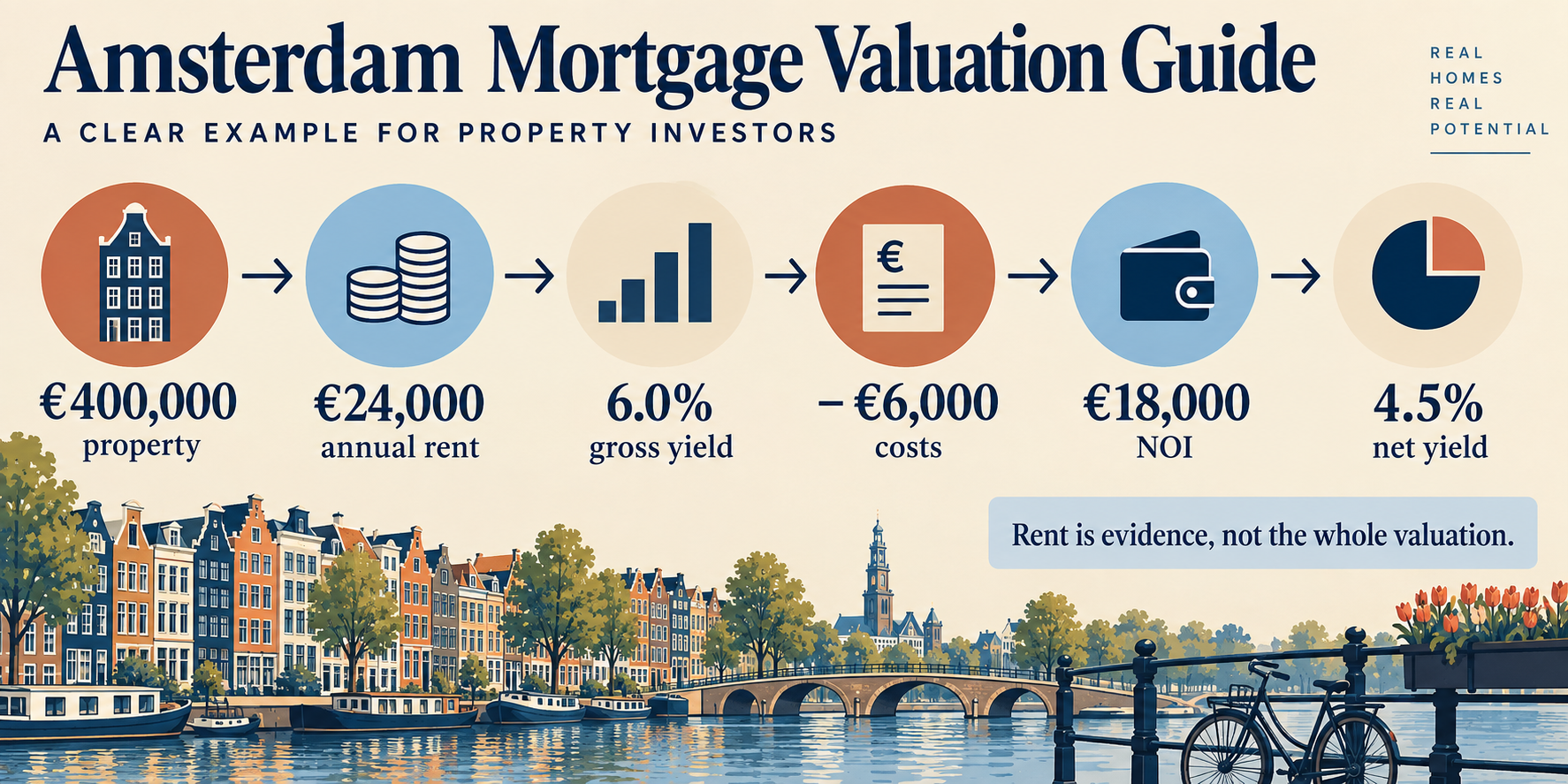
The infographic is a simplified calculation, not a forecast. It turns €2,000 monthly rent into €24,000 annual rent, then divides by an illustrative €400,000 property value for a 6.0% gross yield. Subtracting assumed annual costs of €6,000 leaves €18,000 NOI, or 4.5% when divided by €400,000. Vacancy, maintenance, financing, tax, insurance, management, lease terms and the actual value can change every part of that illustration.
A sound valuation report keeps the property, purpose, valuation date and recipient visible, so you can test whether the conclusion fits your decision.
When you compare quotes, relate the valuation costs in Amsterdam to the scope, inspection, delivery conditions and follow-up you need.
Requirements and constraints
Put these fields in the valuation brief:
- Property: address, dwelling type, floor, usable area, condition, energy information, ownership, leasehold and rights.
- Use: vacant, owner-occupied, partly rented or fully rented; explain any planned change.
- Lease: tenant, start date, term, rent, deposits, service costs, indexation, side letters and arrears if relevant to the valuation purpose.
- Rent evidence: bank records, contract, payment history, market comparison and the measurements or facilities used for a WWS assessment.
- VvE and building: deed of division, budget, reserve fund, minutes, service charges, maintenance plans and major decisions.
- Works and permissions: permits, plans, invoices, structural information and the intended value before or after work.
- Purpose and date: purchase finance, refinancing, rented-state value, value after improvement or another clearly stated decision.
- Recipient: lender, validator, adviser or another named report user, with the accepted form, validation and deadline. The lender’s investment policy can distinguish an owner-occupied loan from a rental-property loan. Ask which rent, debt, value, loan-to-value and document assumptions apply. A valuer can explain the property evidence; a lender decides whether the application fits its product. Rental classification also has uncertainty. A contract may fall under a different regime depending on its date, property characteristics and current rules. Record the inputs and the date of the calculation instead of presenting a WWS estimate as permanent.
Step by step: prepare an investor mortgage valuation
1. Get the investment lender’s instruction
Ask whether the lender needs vacant possession, rented-state market value, value after work or another purpose. Confirm the report form, validation process, report-age rule, recipient, accepted rent evidence and finance deadline.
2. Establish the property and rights
Record the address, dwelling type, usable area, ownership, leasehold, energy information, condition and current use. Mark whether the purchase is an apartment, whether a VvE applies and whether any restriction limits letting or alterations.
3. Verify the lease and rent evidence
Keep the signed lease, amendments, payment history, deposits, service-cost breakdown and rent-indexation terms together. Note the start date and any vacancy or arrears. A proposed rent should be labelled as a proposal, not as current income.
4. Check WWS, VvE and permissions
List the measurements, energy data, facilities and contract facts behind a WWS estimate. Add VvE minutes, reserve-fund information, service charges and maintenance decisions. Check lender, municipality, leasehold and building rules before assuming that a rental or renovation plan can proceed.
5. Define date, purpose and recipient
Write one clear sentence: “Please value this property for [purpose] as at [date], for review by [recipient], taking account of [vacant or rented state] and [planned works].” Add the documents the recipient has requested and the date by which the report must arrive.
6. Inspect, reconcile and submit
Confirm the scope, inspection timing, fee arrangement and delivery method. When the report arrives, check address, rights, use, lease assumptions, market value, comparable evidence, date, limitations and recipient. Reconcile any difference between the report and the rent or cost calculation before submission.
Scenarios and variations
The rent produces a simple gross-yield illustration
Suppose a property is represented by an illustrative value of €400,000 and the current rent is €2,000 per month:
€2,000 × 12 = €24,000 annual rent
The simple gross-yield arithmetic is:
€24,000 ÷ €400,000 × 100 = 6.0%
Neither input is automatically the value or the lender’s accepted income. A changed lease, vacancy period, service-cost treatment or professional valuation can change the comparison.
Costs reduce the simple illustration
Assume, only for the illustration, €6,000 of annual operating costs:
€24,000 - €6,000 = €18,000 NOI
The simplified net-yield comparison becomes:
€18,000 ÷ €400,000 × 100 = 4.5%
NOI here is a plain arithmetic label for the example. It does not include every possible cost and does not forecast vacancy, repairs, financing, tax, insurance or management.
The apartment has VvE exposure
The WWS position is uncertain
Use the measurements, energy information, facilities and contract facts to form a documented estimate. Keep the estimate dated and label missing inputs. The current framework distinguishes up to 186 points from 187 points or more, but the applicable rent and contract treatment still depends on the actual records.
The investment depends on renovation
Separate the current state, budget, permit, construction risk, planned rent and intended completion date. If the lender needs a value before and after work, give each question its own assumptions. Do not use a projected post-renovation rent as if it were current evidence.
If you still have a question about the property, purpose or date, contact Taxateur Amsterdam with the question and without personal attachments.
Common mistakes and stalled preparations
- Treating rent as market value: keep lease income and the property valuation as separate columns.
- Capitalising a proposed rent as current income: label it as proposed and record the evidence behind the assumption.
- Using gross yield as return: include a separate cost list and state what the simple calculation leaves out.
- Ignoring contract date and WWS inputs: record measurements, energy data, facilities and the date of the assessment.
- Leaving VvE records until after inspection: request minutes, budget, reserve-fund information and planned maintenance early.
- Assuming permission to rent: check lender, municipality, leasehold, VvE and contract restrictions.
- Mixing owner-occupied and rented-state assumptions: state the use and valuation purpose in the valuation purpose sentence.
- Assuming an earlier report will be accepted: obtain the current recipient’s confirmation of purpose, age, format and validation. When the preparation stalls, write down the missing fact, the person who can answer it and the date needed. The valuer can resolve a property or market-value question, the lender can resolve product conditions, and a tax or legal adviser can resolve personal consequences.
After the report: review and repeat
Keep the purchase agreement, lease, rent evidence, WWS inputs, VvE records, lender instruction and final report together. Check property identity, rights, use, purpose, valuation date, market value, lease assumptions, supporting evidence, limitations and recipient before submission. Repeat the check when rent, lease, tenant, ownership, property condition, WWS inputs, VvE position, planned work, valuation date, lender or recipient changes. A new fact can require a new valuation brief even when the address is unchanged.
FAQ
Does rent determine the market value?
No. Rent is evidence about use and income. Market value is an opinion for a stated property, date and purpose that also considers rights, condition, location, comparable evidence and assumptions.
Is a 6.0% gross yield a good investment result?
The calculation only divides annual rent by an illustrative value. It does not include every cost, vacancy, financing, tax, insurance, management or future change. A lender and investor may also use different assumptions.
What is the difference between gross yield and net yield?
Gross yield uses rent before the selected costs. The simple example in this explanation subtracts €6,000 of assumed annual costs from €24,000 rent to produce €18,000 and a 4.5% comparison. It is not a complete investment return measure.
Do 186 or 187 WWS points settle the rent?
They are important current boundaries in the Huurcommissie framework, but the actual outcome depends on measurements, facilities, energy information, contract date and applicable rules. Keep the calculation dated and have a qualified professional confirm a disputed tenancy question.
Can a fully rented property use the same mortgage-interest treatment as my home?
Not automatically. The tax treatment of a fully rented home differs from an owner-occupied home. Take the personal tax position to a qualified adviser.
Can I reuse an owner-occupied valuation for a rental lender?
Ask the new recipient to confirm purpose, use, valuation date, report age, format, validation and rental-evidence requirements. A report based on owner-occupied use may not answer a rented-state or investment-product question.
When to recheck the figures
Rental rules, WWS boundaries, tax treatment and lender requirements can change. Recheck the relevant official guidance, contract dates and calculation inputs before carrying the figures into a new investment decision. Keep the property facts, lease evidence, purpose, date, recipient and assumptions together so each number retains its meaning.
Put the property rights, current lease, rent evidence, WWS inputs, VvE records and lender instruction in one dated set of records. If the investment case depends on a rent, yield or financing assumption, bring that question to the right professional instead of treating an illustrative calculation as a valuation.
Ask a question about an investor valuation