Mortgage valuation in Amsterdam for business owners: separate home and work
Prepare a business-owner mortgage valuation in Amsterdam by separating the home, business use, ownership and accounts before the property inspection.

TL;DR: Keep home, work and finance questions separate
Prepare a business-owner mortgage valuation by stating the address, purpose, valuation date and report recipient, then describing the private and business parts of the building separately. Ask the lender which report, validation and use description it accepts. Put the floor plan and property records together with the valuer’s brief, keep accounts with the tax or income professional, arrange the inspection and compare the report with the written instruction. Keep these questions apart: market value, home-value ceiling, business-property treatment, depreciation, income capacity and mortgage acceptance. The same building can appear in all six questions, but each question needs its own evidence and decision-maker.
- Ask the lender for the accepted report, validation, recipient and deadline.
- State the home, business or mixed-use purpose and one valuation date.
- Mark private, business and shared areas on a floor plan.
- Gather title, leasehold, permits, plans and property records; keep accounts separate.
- Arrange the inspection and review use, rights, assumptions and recipient before delivery. The 100% home-value ceiling concerns the property-value part of the mortgage; income and other obligations remain separate.
To assess a mixed-use property, a business owner can frame the building evidence around property valuation questions, then keep business and mortgage issues separate.
Is the property both a home and a business?
If you live above a studio, run a practice from home or buy mixed-use premises, one address can hold several questions. Describe the private and business areas separately so the valuer, lender and tax adviser each receive the facts relevant to their decision.
- buying a home that includes a studio, office, shop or practice;
- moving a business into an owned building;
- using part of a home for work and need to describe the space accurately;
- applying for a mortgage while company accounts and property records are being prepared; or
- trying to explain which parts of the building are private, commercial, rented or shared. Have the address, floor plan, ownership details, proposed use, lender or adviser, valuation date and deadline available. Keep contracts, accounts, identity documents and tax records with the professional who requests them. A general question form only needs the category of question.
Before you arrange the valuation
Draw the building in three layers: home, work and accounts. The home layer contains the private rooms, main residence and private mortgage purpose. The work layer contains the business area, access, facilities, lease or operating use. The accounts layer contains the question for the bookkeeper or tax adviser. The layers can relate to the same building without producing the same conclusion. The valuer needs the layout and use. The lender needs the accepted report and affordability records. The tax adviser needs facts about ownership, use and the business records. The private or business property treatment depends on the facts of use and ownership, not on the mortgage label alone.
Why mixed use changes the application
The valuer needs to understand what the property is, how it is used and which rights attach to each part. A ground-floor shop and an upstairs home may require different evidence from a home with a desk in one room. A separate entrance, facilities, lease or business tenant can change the questions that belong in the brief.
If your Amsterdam decision also involves amsterdam mortgage valuation brief, keep its lender requirements separate from the property question here.
The lender’s mortgage assessment adds income, debt, costs and product rules. The tax adviser adds private or business treatment and the accounts. A market-value conclusion does not settle those questions. A business classification does not set the market value.
The private-home business-use conditions depend on facts such as the room, access and use of the home. Record those facts without presenting a general explanation as a personal tax conclusion.
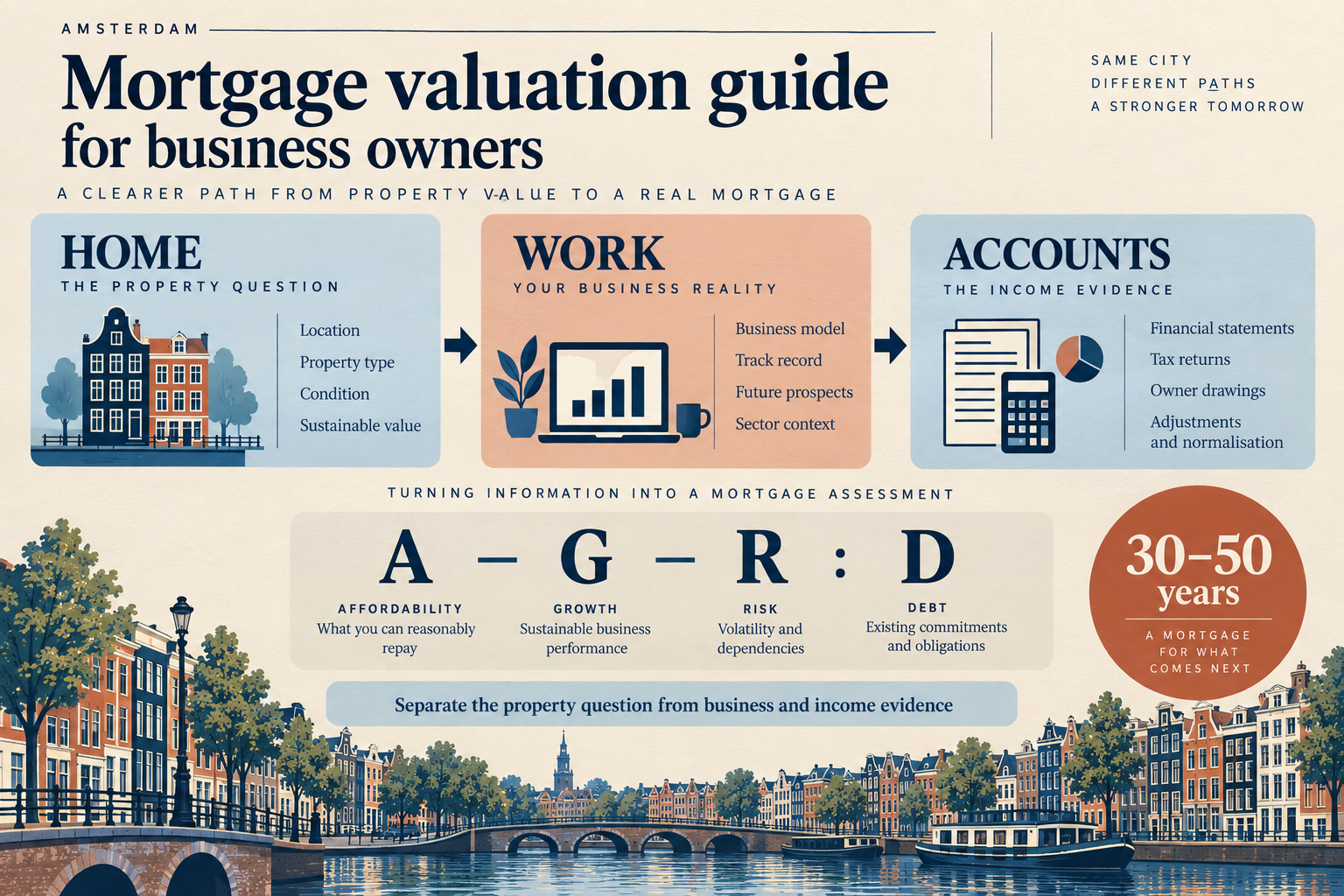 The infographic separates the property question from the business and income questions. HOME and WORK describe property facts, ACCOUNTS belongs to the financial records, the formula is the cited depreciation notation and 30–50 years is a general building period rather than a market-value or lending result.
When you compare quotes, relate the valuation costs in Amsterdam to the scope, inspection, delivery conditions and follow-up you need.
A sound valuation report keeps the property, purpose, valuation date and recipient visible, so you can test whether the conclusion fits your decision.
Requirements and constraints
Place these fields in the property brief:
- Address and rights: address, ownership, title, leasehold, apartment rights and any split between units.
- Use: private home, business area, shared area, rental area, access and facilities.
- Purpose: purchase finance, refinancing, renovation, business-property purchase or another named decision.
- Dates: valuation date, inspection date, report delivery date and lender deadline.
- Recipient: lender, validator, adviser or another named report user.
- Records: floor plan, deed, lease, permits, plans, invoices, VvE records, maintenance decisions and known defects.
- Accounts question: the professional who handles private or business treatment, depreciation and income evidence.
The recipient should be able to match the report fields for this valuation to the address, rights, use, date, assumptions and evidence.
The 2026 NHG limit is €470,000, or €498,200 with the stated energy-saving provisions, subject to the associated conditions.
Keep the threshold separate from a mixed-use home’s market value and from the lender’s assessment of income and loan structure.
Step by step: prepare the business-owner mortgage valuation
1. Put the lender’s report requirement in writing
Ask for the accepted report type, validation path, recipient, report-age rule and delivery date. Ask whether the lender needs the whole building, a private unit, a business area or a value split. Keep the answer with the address.
2. Write the property question
Use one sentence: “Please value [address] for [purpose] as at [date], for [recipient].” Add the private and business use, planned changes and any value-before-or-after-work question. A clear valuation brief prevents the valuer from guessing which part of the building matters.
3. Mark the areas and rights
Use a current floor plan. Mark private rooms, business rooms, shared circulation, separate entrances, facilities, storage and any leased part. Add apartment rights, leasehold terms or a deed of division where relevant. The drawing is evidence for the property question; it is not a tax allocation by itself.
4. Separate the accounts question
Write the question for the tax adviser or bookkeeper: private or business treatment, business use, depreciation, purchase costs or income evidence. Do not place accounts in the property records unless the requesting professional needs them. The valuer can describe the property and use without deciding the accounts treatment.
5. Arrange inspection and delivery
Confirm access to every relevant part of the building, the person who will attend, the scope and the delivery date. Tell the valuer about a business tenant, separate entrance, building work, permit, defect or planned change that affects the valuation purpose.
6. Match the report to the instruction
Compare address, rights, use, purpose, valuation date, market-value figure, assumptions, limitations, recipient, validation and delivery. A report can describe the property well and still miss the lender’s requirement if the intended unit or recipient is wrong.
Scenarios and variations
A home contains one work room
Record the room, access and business use as facts. The tax treatment may depend on conditions beyond the floor plan. The valuation brief should still identify whether the lender wants the whole home valued and whether the work use changes access, condition or market evidence.
A building has a shop below and a home above
Separate the floors, entrances, facilities, ownership and any lease. Give the lender the report purpose and ask whether it needs one value, a split or a particular description. Give the tax adviser the ownership and use facts for the accounts question.
The accounts use a depreciation formula
The business-property depreciation formula uses acquisition value, land value, residual value and useful life as separate inputs. The stated annual formula is (A - G - R) : D. It does not calculate market value. The Tax Administration says buildings often have a 30 to 50 year useful life and land is not depreciated.
The building is leasehold or an apartment
Add leasehold terms, canon information, dates, deed of division, VvE budget, minutes, reserve-fund information and major maintenance decisions. Mark which facts concern the private home and which concern a commercial or shared part.
The application uses NHG
The 2026 NHG amount is €470,000, or €498,200 with the stated energy-saving provisions. That published limit does not decide whether a mixed-use property, loan, income records or report meets all current conditions. Ask the lender which property area, value and report form it includes.
Common mistakes and stalled preparations
- Calling every room business property: record use, access, facilities and ownership as separate facts.
- Letting one floor plan decide tax treatment: send the complete facts to the tax adviser.
- Using business accounts as property evidence: keep accounts with the income or tax question.
- Valuing the wrong part of the building: state whole-building, unit or split-value scope before inspection.
- Treating the 100% figure as a loan promise: the home-value ceiling does not answer income, costs or business obligations.
- Quoting the NHG limit as eligibility: the published amount sits alongside the rest of the NHG and lender conditions.
- Omitting a tenant, permit or separate entrance: add facts that can change use, access or market evidence.
- Sending contracts or accounts through a general form: ask about the valuation purpose without attaching sensitive records. When the preparation stalls, name the missing fact and its owner. The valuer can answer a property or market-value question. The lender can answer report and affordability conditions. The tax adviser can answer private or business treatment. The bookkeeper or income professional can answer the accounts evidence.
If you still have a question about the property, purpose or date, contact Taxateur Amsterdam with the question and without personal attachments.
After the report: review and repeat
Keep the lender instruction, floor plan, title and leasehold records, inspection notes and completed report together. Compare address, rights, use, purpose, valuation date, report recipient, market-value figure, assumptions, validation and delivery format before delivery. Repeat the comparison when the layout changes, a business starts or ends, a tenant arrives, ownership changes, a permit is granted, the lender changes, the valuation date moves or a different recipient is named. A change in use can affect the property description without changing the street address.
FAQ
Does business use change the mortgage valuation?
It can change the facts and evidence that belong in the valuation purpose. The lender decides what report and use description it accepts, while the valuer describes the property for the stated purpose and date.
Does a valuation decide whether the building is private or business property?
No. The classification depends on facts of ownership and use and belongs with the relevant tax professional. A valuation can record the physical layout and use evidence.
What does (A - G - R) : D mean?
It is the depreciation formula described by the Tax Administration: acquisition value minus the relevant land value and residual value, divided by useful life. It is an accounting explanation, not a market-value or loan calculation.
Does a 30 to 50 year period mean the building is worth less each year?
No. The period is a general useful-life input in the depreciation explanation. Market value follows a different valuation question and evidence.
Is the 2026 NHG limit €470,000 or €498,200?
The published amount is €470,000, with €498,200 stated for loans including qualifying energy-saving provisions. The lender confirms the conditions and whether the property and loan fit the current NHG framework.
Can a general contact form carry my accounts or contracts?
No. Use it for a question about the valuation purpose, property use or report requirement. Keep accounts, contracts, tax records, bank statements and identity documents with the professional who requests them.
When to recheck the figures
Tax Administration explanations, NHG limits and lender report conditions can change. Recheck the €470,000 or €498,200 threshold, the 30 to 50 year explanation and the formula wording when a new application starts. Reconfirm the use, ownership and report scope whenever the building or business changes. Report delivery works best when home, work and accounts remain visible as separate layers. The valuer can then address the property evidence, the lender can assess the mortgage application and the tax adviser can address the business consequences.
A home that also houses a studio, office or shop creates separate property and business questions. Mark the private home, the business area, the ownership structure and the lender's report purpose before the inspection. General questions can go through the contact form; leave contracts, accounts and identity documents out of the message.
Ask a question about a business-owner mortgage valuation