Mortgage valuation in Amsterdam for first-time buyers: check before you bid
Buying your first Amsterdam home? Set the valuation purpose, lender rules, NHG limit, property documents and report date before you bid.

TL;DR: Five checks before you bid
A first-time-buyer mortgage valuation should be arranged around the lender’s instruction and the home you intend to buy. Start by confirming the accepted report form, valuation date and deadline. Then compare the proposed bid with the market-value question, check the 2026 NHG limits if relevant, collect apartment or leasehold records, arrange the inspection and read the finished report before submission. Keep four figures separate: the bid, the market value, the amount the lender may consider after its income assessment and the applicable NHG limit. The government says a mortgage can be up to 100% of home value, while income and other financial obligations still affect the maximum. A valuation gives the market-value part of the application and cannot settle those other questions.
- Ask the lender for its report, validation, date and deadline requirements.
- Define the purpose, property, valuation date and intended report user.
- Gather purchase, VvE, leasehold, permit and renovation records.
- Compare the bid, market value and relevant NHG figures with the lender.
- Commission the report, inspect the result and resolve open points before submission.
If you are also deciding on purchase valuation in Amsterdam, keep that purchase purpose separate from the mortgage or valuation question here.
Are you buying your first Amsterdam home?
Buying your first Amsterdam home brings the bid, lender deadline and property evidence together. Use the valuation to answer the market-value question, and keep NHG, affordability and product conditions with the lender’s assessment.
- preparing a mortgage application for an existing Amsterdam home;
- considering an NHG-backed loan;
- buying an apartment with VvE records to review;
- buying a leasehold property or a home with planned improvements; or
- trying to understand what a report can answer before a bid becomes binding. Have the address, expected purchase price, intended loan, lender or adviser, preferred valuation date and finance deadline to hand. Those facts give the valuer and lender a shared starting point.
Before you start
Write down four questions before booking an inspection:
- Which report form, validation path and age limit will the lender accept?
- What purpose and valuation date must appear in the valuation purpose?
- Which purchase price, market value and NHG figures need to be compared?
- Which property records could affect the description, assumptions or timing? Answering these questions early gives you a cleaner conversation with the lender, mortgage adviser and valuer. Each person can then address the part of the application that belongs to them.
Why the valuation matters for a first home
The bid is the amount you agree to pay. The valuation is an opinion of market value for a stated date and purpose. A lender places that report beside its income assessment, debts, product rules and the property details. The report can support the property-value part of the decision; it does not replace the lender’s affordability assessment.
If your Amsterdam decision also involves mortgage valuation in Amsterdam, keep its lender requirements separate from the property question here.
The Rijksoverheid mortgage borrowing rules state that a mortgage may be up to 100% of the home’s value.
The same source points to income, the interest conditions and other financial obligations as factors in the maximum. You need both a market-value question and a separate borrowing-capacity conversation.
NHG adds another layer.
The NHG limit for 2026 is €470,000.
The limit rises to €498,200 when the loan includes the stated energy-saving provisions.
The announcement also states a 0.4% guarantee fee.
These are product figures for the 2026 NHG framework.
The lender still checks the home, the loan and the application against the conditions that apply to the application.
For an existing home, the NHG purchase-price and market-value rule compares the purchase price with the market value in the valuation report for the NHG possibility.
The lower figure matters in that check.
A bid above the report’s market value can create a cash gap even when the bid sits below the NHG limit.
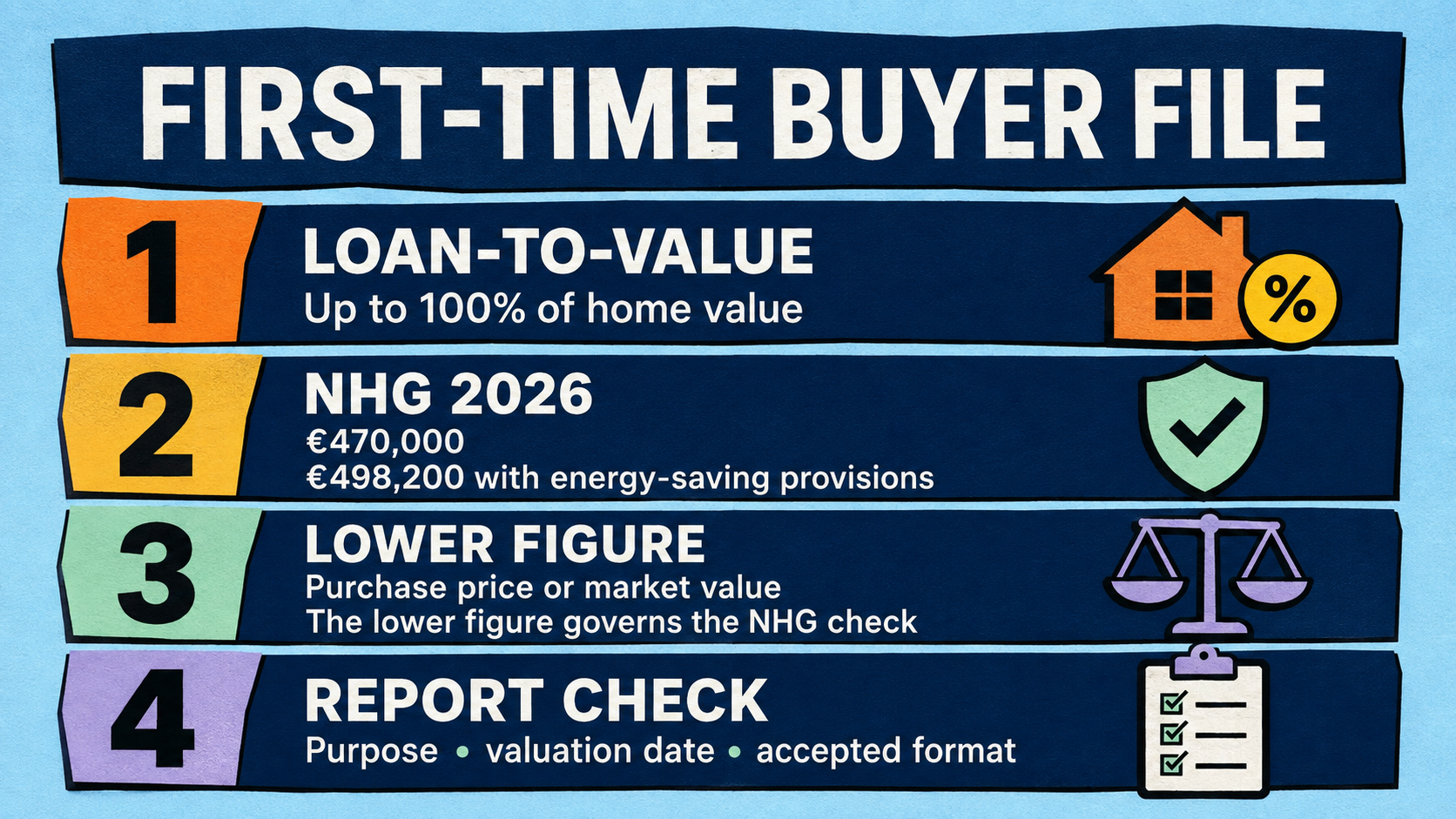
The infographic presents a set of separate questions. The 100% figure describes a ceiling tied to home value. The two NHG amounts describe a 2026 guarantee limit with a stated energy-related increase. The lower-figure panel points to the comparison between purchase price and market value. The report panel reminds you to confirm purpose, valuation date and accepted form.
A sound valuation report keeps the property, purpose, valuation date and recipient visible, so you can test whether the conclusion fits your decision.
When you compare quotes, relate the valuation costs in Amsterdam to the scope, inspection, delivery conditions and follow-up you need.
Use this message when you need a written answer: “For [address], with an expected purchase price of [amount], requested loan of [amount] and valuation date [date], do you accept [report form]? Is validation required? Which report age, recipient and delivery rules apply? Does the application use NHG, and which energy-saving documents or property records should be supplied?”
An Amsterdam first-time buyer can compare the lender’s report, recipient and timing questions with the mortgage valuation requirements for Eindhoven before finalising a mortgage request.
Requirements and constraints
Prepare these fields before you request a valuation:
- Property: address, dwelling type, floor, usable area and any unusual features.
- Purchase: agreed or expected price, purchase conditions and the date by which finance must be arranged.
- Purpose: purchase finance, refinancing, an increase or another clearly stated lending decision.
- Valuation date: the date the market value must represent, plus the inspection and report deadlines.
- Recipient: lender, validator, mortgage adviser or another named report user.
- Property records: VvE budget and minutes, deed of division, service charges, leasehold terms, permits, floor plans, renovation plans and known defects. The NHG conditions for the 2026 report and loan set conditions around the report, the property and the total loan in the NHG framework. Ask the lender which version, validation and report form it accepts for your application. A physical inspection, an accepted valuation report or a particular delivery method may be part of that instruction. Keep the cash question visible. If the bid exceeds the market value, the difference can require funds outside the mortgage calculation. Purchase costs, advice, validation, notarial work and planned improvements can create separate funding needs. Ask the mortgage adviser to map those amounts before you treat the valuation as a complete budget.
Step by step: prepare the valuation
1. Get the lender’s instruction
Ask for the accepted report form, validation path, report-age rule, intended recipient and finance deadline. Save the wording with the property records. If the lender’s answer comes by phone, send a short written summary and ask for confirmation.
2. Fix the valuation question
Use one clear sentence: “Please value this home for the proposed purchase and mortgage application as at [date], for review by [recipient].” Add the address, dwelling type and any separate request for an after-improvement value. The valuer can then see the purpose before the inspection.
3. Check the bid against the value question
Put the expected price, requested loan, market-value question and NHG position in one note. Mark which number comes from the purchase agreement, which one comes from the valuation and which one still depends on income or lender policy. This prevents a bid from being treated as proof of value.
4. Assemble the property records
For an apartment, collect the deed of division, VvE budget, recent minutes, reserve-fund information, service charges and any major decisions. For leasehold, add the terms, canon information and relevant dates. Add permits, plans, invoices and a building report when improvements or defects affect the application.
5. Commission and schedule the inspection
Confirm the valuer, scope, fee arrangement, inspection timing and delivery date. Check that the report will go to the recipient named by the lender. Keep the confirmation and the property documents together so a missing record can be found before the inspection.
6. Review before submission
Read the address, purpose, valuation date, property description, market value, comparable evidence, assumptions, limitations and recipient. Compare the delivery date with the finance deadline. Ask about an error or unresolved assumption before the report enters the lender’s records.
Scenarios and variations
The bid is above the market value
Use an illustration to see the gap. Suppose a first-time buyer offers €450,000 and the report’s illustrative market value is €440,000. The difference is:
€450,000 - €440,000 = €10,000
If the requested loan were €440,000, the simple loan-to-value arithmetic would be:
€440,000 ÷ €440,000 × 100 = 100%
This calculation leaves the €10,000 difference outside that value comparison, alongside any other buying costs. It does not predict the lender’s income assessment, product decision or available cash. Take the numbers to the lender or mortgage adviser before changing the bid.
The home sits near an NHG limit
The 2026 NHG amount is €470,000. The amount with the stated energy-saving provisions is €498,200. A home, loan and report still have to meet the conditions attached to the chosen application. Ask whether the planned work qualifies as an energy-saving provision and which documents the lender needs.
The NHG announcement states a 0.4% guarantee fee. At an illustrative loan of €400,000, the arithmetic is:
€400,000 × 0.004 = €1,600
That is a calculation of the published percentage. The lender can explain how the fee appears in the application and what other costs sit beside it.
The home is an apartment
The apartment’s value conversation includes the private unit and the building context. VvE decisions, reserve funds, service charges, maintenance plans and rights in the deed can affect the information the valuer needs. Send the records early when a major repair or financial decision is under discussion.
The home is leasehold or will be improved
Lease terms, canon dates and conversion conditions belong in the property records. For planned improvements, separate the current state, budget, permissions and intended result. A lender may ask for a value before work and a value after work, each with its own assumptions and evidence.
If you still have a question about the property, purpose or date, contact Taxateur Amsterdam with the question and without personal attachments.
Common mistakes and stalled preparations
- Booking before asking the lender: request the accepted form and validation path first.
- Treating the bid as the value: keep the purchase price and market-value opinion in separate columns.
- Using the 100% figure as a budget: send income, debts and other obligations to the lender or adviser.
- Leaving the NHG position until the end: compare the 2026 limit, energy-related increase and property conditions early.
- Forgetting VvE or leasehold records: make a document list and mark who will supply each missing item.
- Counting the deadline from the inspection: ask which valuation date, report date and delivery date the recipient uses.
- Assuming a report will be accepted everywhere: receive the current recipient’s confirmation before relying on an earlier report. When a preparation stalls, write three lines: the open fact, the person who can answer it and the date the answer is needed. A lender can resolve a product question, a valuer can resolve a property or market-value question, and a mortgage adviser can map income and cash requirements.
After the report: review and repeat
Keep the purchase agreement, lender instruction, property documents and final report together. Before you submit, check five items: address, purpose, valuation date, market value and intended recipient. Add the report format, validation and any stated assumptions to the same checklist. Start the check again when the bid changes, the property changes, the valuation date moves, the lender changes, planned work becomes part of the application or the report will go to another recipient. A changed fact can alter the question even when the address stays the same.
FAQ
Can a valuation make my first-home bid affordable?
The report addresses market value for its stated purpose and date. The lender separately reviews income, debts, interest conditions, product rules and available funds. Discuss those parts together before you commit to a bid.
Can I borrow 100% of the market value?
The government describes a maximum of 100% of home value, subject to the rest of the lending assessment. The market-value ceiling does not establish how much your income and obligations support.
What are the 2026 NHG amounts?
The published 2026 NHG limit is €470,000. It is €498,200 when the loan includes the stated energy-saving provisions. The lender confirms whether the property and application meet the associated conditions.
What happens when the report is below the purchase price?
The difference can become a cash requirement or lead to a new decision about the bid and finance structure. Use the purchase agreement, report and lender calculation together. An adviser can explain how the gap interacts with the rest of the application.
Do I need an inspection?
The accepted report form and lender instruction decide which valuation method applies. Ask whether a physical inspection, validation or a particular report format is required before you book.
Can I reuse a report from another lender?
Ask the new recipient to confirm purpose, valuation date, report age, format, validation and recipient rules. Keep that answer with the report. Acceptance depends on the current lender and the application.
When to review the decision again
Recheck the lender’s current instruction when the product, purchase price, valuation date, property condition or intended recipient changes. Keep the source links and figures beside the date on which you reviewed them. That small record makes it easier to see which number belongs to the application and which question still needs an answer.
Have the lender's accepted report format, valuation date and submission deadline in writing. Check the purchase price, intended loan, NHG position and apartment or leasehold documents together, then bring any open question to the right person before the inspection.
Ask a question about a starter mortgage valuation