Purchase valuation in Amsterdam for expats: make the cross-border purchase clear
Prepare an Amsterdam purchase valuation as an expat by separating the property question from currency, lender, tax and document questions.

TL;DR: Five checks for a cross-border purchase
Start with the Dutch property’s address, rights, purpose and valuation date. Ask the lender how it handles foreign income, currency, report recipient and translations. Collect property records and document categories, arrange the inspection and review the report before the finance deadline. Keep the market-value opinion separate from income, tax and product decisions.
- Confirm the lender’s report, date, recipient and document rules.
- Define the property and market-value question.
- Organise property records, translations and currency questions by owner.
- Commission the report with the accepted purpose and delivery method.
- Review the report and send tax or income questions to the right adviser.
If you are also deciding on purchase valuation for investors, keep that purchase purpose separate from the mortgage or valuation question here.
A sound valuation report keeps the property, purpose, valuation date and recipient visible, so you can test whether the conclusion fits your decision.
When you compare quotes, relate the valuation costs in Amsterdam to the scope, inspection, delivery conditions and follow-up you need.
If you are also deciding on purchase valuation in Amsterdam, keep that purchase purpose separate from the mortgage or valuation question here.
Are you buying an Amsterdam home from abroad?
You are buying an Amsterdam home across borders, perhaps while living abroad or earning in another currency. A clear purchase brief keeps the property, purpose, date and recipient together; currency, income, tax status, translation and lender acceptance then have named owners.
Before you start
Write five headings:
- Property: address, rights, condition and apartment or leasehold facts.
- Purpose: purchase, finance, refinancing or another stated use.
- Currency: income currency, conversion date and lender question.
- Documents: source, date, translation and issuing authority.
- Recipient: lender, validator, adviser or another named user.
This makes it clear which question belongs to the valuation and which belongs to a lender, adviser or tax authority.
Before you contact the valuer, have the address, purpose, valuation date, report recipient, accepted report format, income currency, translation question, leasehold or VvE position and finance deadline ready.
Why international preparation needs clear ownership
If your Amsterdam decision also involves mortgage valuation for expats, keep its lender requirements separate from the property question here.
The Rijksoverheid mortgage explanation describes a home-value ceiling of up to 100% while income, interest conditions and other obligations also affect borrowing. The property valuation can supply the market-value evidence. It cannot decide income capacity.
If you are also deciding on purchase valuation for first-time buyers, keep that purchase purpose separate from the mortgage or valuation question here.
The NHG 2026 limit is €470,000, or €498,200 with the stated energy-saving provisions, subject to the rest of the conditions.
The NHG foreign-currency explanation keeps the loan in euros and leaves the lender to assess income and currency risk.
If you are also deciding on purchase valuation for home movers, keep that purchase purpose separate from the mortgage or valuation question here.
The Tax Administration’s qualifying non-resident explanation describes a tax category with country and 90% Dutch-taxed-income conditions. That category does not decide the property’s market value or the lender’s product decision.
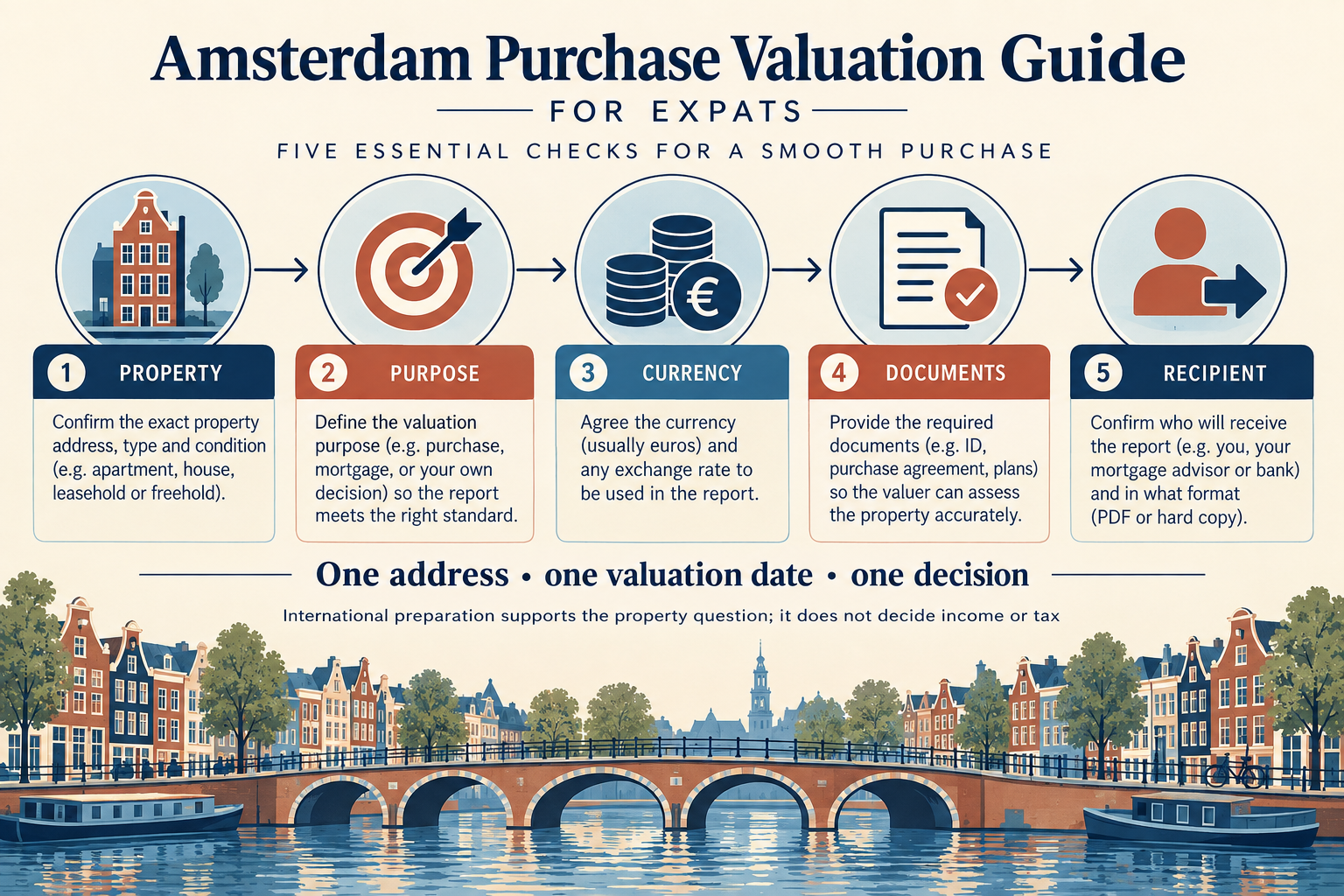
The infographic gives each question a place before the report. Property and purpose go to the valuation brief. Currency and income go to the lender. Documents need source and acceptance checks. The recipient controls the report delivery.
An international buyer can place a valuation report for buying a house in the Netherlands in the broader reporting context; the Amsterdam address, date and recipient still determine the brief.
Requirements and constraints
Prepare:
- address, dwelling type, floor area, rights, leasehold and known defects;
- purchase price, purpose, valuation date and finance deadline;
- lender name, accepted report form, validation and recipient;
- income currency, employer or business context and conversion question;
- original document source, issue date, translation need and adviser owner;
- apartment VvE documents, permits, plans and renovation records;
- a separate tax-status question for the Tax Administration or adviser.
Do not let a translation, currency conversion or tax label replace the property facts. The report should say what property question it answers and who receives it.
Step by step: prepare the valuation
1. Ask the lender for the accepted method
Confirm report format, inspection method, recipient, validation, age and delivery deadline. Ask how foreign income and translated documents enter the lender’s process.
2. Fix the property question
Use one sentence: “Please value [address] for [purchase or finance] as at [date], for review by [recipient].” Add leasehold, apartment or planned-work facts.
3. Sort documents by owner
Keep property deeds, plans and condition records with the valuation brief. Keep income, currency and tax records with the lender or adviser. Record source and date without sending private documents in a general enquiry.
4. Check the cross-border calculations
Ask the lender which exchange rate, income period and risk treatment it uses. Ask the tax adviser whether qualifying non-resident conditions or mortgage-interest rules apply. These are separate from the market-value opinion.
5. Commission and schedule
Confirm the fee, inspection, delivery method and intended recipient. Keep the written instruction with the property records.
6. Review before delivery
Check address, rights, date, purpose, market value, assumptions, limitations, report form and recipient. Send open income or tax questions to the relevant owner.
Scenarios and variations
A purchase-price gap
Suppose an international buyer agrees an illustrative price of €600,000 and the report’s illustrative market value is €575,000:
€600,000 - €575,000 = €25,000
That is a property and finance question. It does not predict how the lender treats income, cash, taxes or the bid.
Income is paid in another currency
Record the currency, payment history and lender question. Ask the lender how it measures income and currency risk. Do not convert a figure in the valuation brief without stating the date and purpose of the conversion.
The buyer may be a qualifying non-resident taxpayer
The 90% condition belongs to the tax category described by the Tax Administration. It does not prove status without the relevant country, income and tax facts. Ask a tax adviser to apply the current rules.
The home is leasehold or an apartment
Add lease terms, canon dates, VvE records, service charges and planned decisions. These property facts can affect the valuation brief even when the buyer’s income is accepted.
Common mistakes and stalled preparations
- Sending an income question to the valuer: send it to the lender or adviser.
- Using a translated document without source details: record issuer, date and acceptance owner.
- Treating the 100% figure as approval: keep home value separate from income assessment.
- Converting currency without a date: ask which rate and period the lender uses.
- Forgetting the report recipient: confirm acceptance before commissioning.
- Leaving leasehold or VvE records until the end: add them to the property list early.
When the preparation stalls, list the open fact, owner and date. One owner should answer each question before it is folded back into the purchase plan.
If you still have a question about the property, purpose or date, contact Taxateur Amsterdam with the question and without personal attachments.
After the report: review and repeat
Repeat the check when employer, income currency, residency, lender, property, bid, valuation date, report recipient or translation requirement changes. Keep the property report and cross-border finance notes as dated records.
FAQ
Does a valuation assess my foreign income?
No. It addresses the property and market value for the stated purpose and date. The lender or adviser assesses income, currency and affordability.
Can I borrow 100% of the market value?
The government describes a ceiling of up to 100% of home value, subject to the full lending assessment. Income and obligations still matter.
Can NHG use foreign-currency income?
The NHG explanation says the loan remains in euros and the lender assesses whether foreign-currency income and risk treatment are appropriate. Ask the current lender.
Does the 90% tax rule qualify me automatically?
No. It is part of the qualifying non-resident tax category and depends on the stated country and income facts. A tax adviser can assess the position.
Do documents need translation?
Ask the report recipient, lender or adviser which documents require translation, who may translate them and which source and date details must remain visible.
Can a report commissioned for another lender be reused?
Only after the new recipient confirms purpose, date, age, format, validation and acceptance. Keep that answer in writing.
When to review the decision again
Date the lender instruction, exchange-rate question, tax-status note and property records. Recheck them when the buyer, property, currency, lender or report recipient changes. Keep the market-value answer readable beside the other decisions without merging them.
Write the address, purchase purpose, valuation date, report recipient and document categories in the brief. Keep currency, income, residency and tax questions with the lender or adviser. Use the contact form for a general question without sending passports, payslips or other personal documents.
Ask about an expat purchase valuation