Sale valuation in Amsterdam: read the market trend without pricing your home by it
A sale valuation in Amsterdam starts with the value question and date. Read the CBS index, asking price and offer as separate numbers before preparing the property records.

TL;DR: Five checks before pricing the sale
A sale valuation gives an opinion of market value for one property and one stated date. The asking price belongs to a sales strategy, and an offer belongs to a buyer’s negotiation. Use the CBS index to frame the city market, then use property evidence for the report.
- Name the decision and intended report recipient.
- Fix the valuation date and explain any sale timetable.
- Gather property, leasehold, VvE, renovation and maintenance documents.
- Commission the report with an independent, factual brief.
- Read the value and assumptions, then discuss asking price and timing with the sales professional.
If your Amsterdam decision also involves mortgage valuation for home movers in Amsterdam, keep its lender requirements separate from the property question here.
If you are also deciding on purchase valuation in Amsterdam, keep that purchase purpose separate from the mortgage or valuation question here.
Before you set the brief, define the market value in property valuation so the purpose and valuation date share one meaning.
Are you preparing to sell an Amsterdam home?
If you are preparing to sell an Amsterdam home, a sale valuation can give you a dated market-value reference before you choose a sales approach. It helps you organise the property evidence; asking price, presentation and negotiation remain decisions for the professional handling the sale.
Before you start
Write down the decision: personal orientation, co-owner discussion, finance, division or preparation for sale. Add the property address, valuation date, intended report reader and timing. Keep market value, asking price and offer as separate lines from the first conversation. Use this seller brief: “Address [ ], decision [ ], valuation date [ ], report recipient [ ], property facts [ ], leasehold/VvE [ ], renovation or maintenance [ ], comparable evidence [ ], sale timetable [ ].”
What a sale valuation answers
Market value is an evidence-based opinion within a defined valuation purpose. Asking price is a choice about positioning, timing and presentation. Offer is a buyer’s response under specific terms. These amounts can sit together in a sale records while answering different questions. The NRVT objectivity and independence rules describe a valuer’s own judgment and the need to consider actual or apparent interests. Give the valuer the property facts and the purpose. Discuss presentation, marketing and negotiation with the professional responsible for those parts.
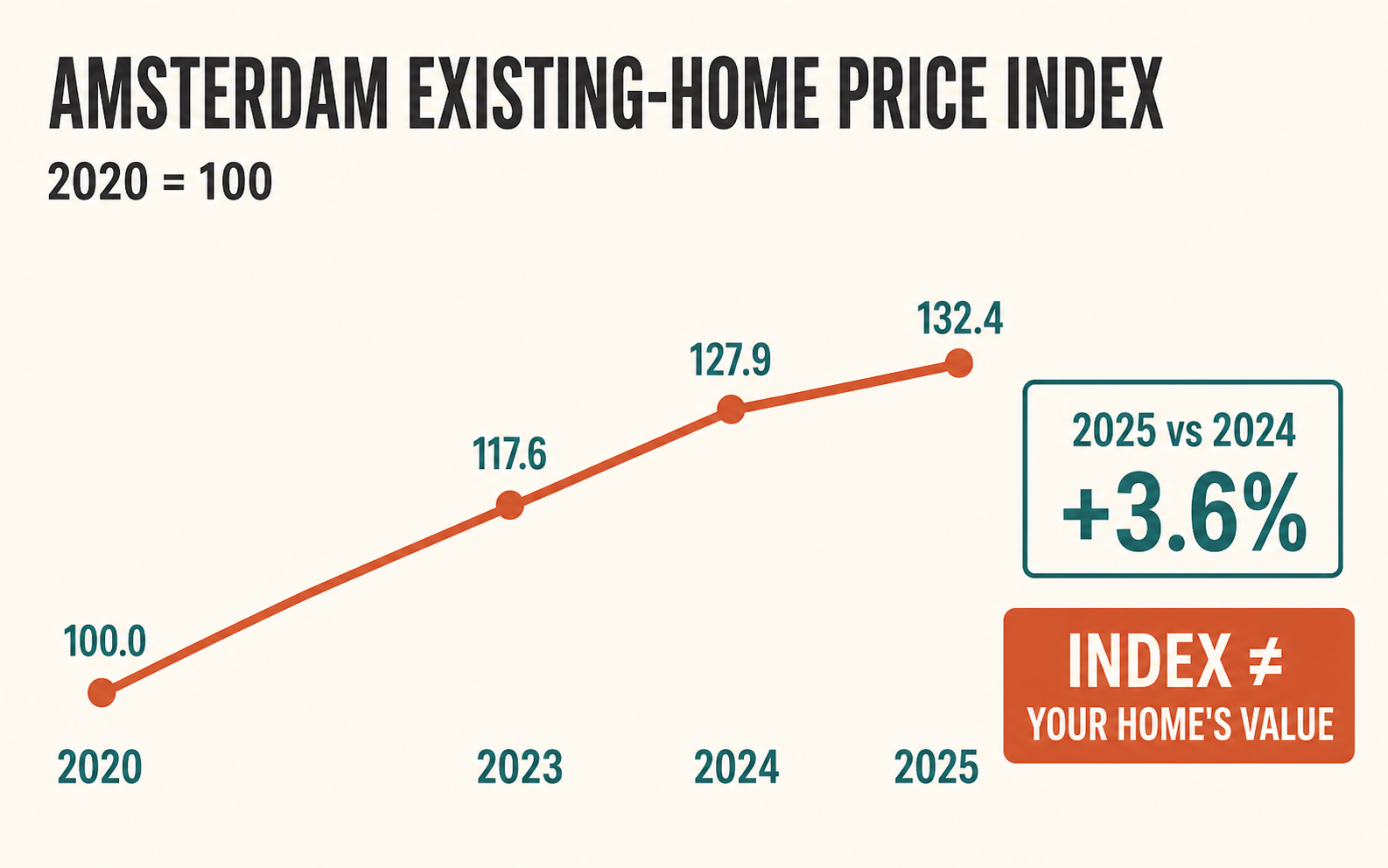
The CBS figure in five steps
Number: the Amsterdam existing-home price index is 132.4 for 2025, with 2020 = 100.0. Context: it covers existing homes sold to private buyers. Comparison: 2025 is 4.5 index points above 127.9 in 2024, which CBS reports as a 3.6% annual increase. Method: CBS combines Kadaster sale records and WOZ values. Use: the series can frame a timing question, while the home’s facts and comparable evidence support the property-level report. The table also lists 133.5 for Q2 2026, 0.8% above the same quarter of 2025. A quarterly comparison and an annual comparison describe different periods. Keep the period beside the number. The index cannot tell you how leasehold, foundation condition, floor area or renovation affects one property. The CBS Amsterdam price change in Q2 2025 reported a 4.3% Amsterdam year-on-year increase for Q2 2025. The current index contains later observations. Record the source date whenever the figure is used in a conversation.
A sound valuation report keeps the property, purpose, valuation date and recipient visible, so you can test whether the conclusion fits your decision.
When you compare quotes, relate the valuation costs in Amsterdam to the scope, inspection, delivery conditions and follow-up you need.
The CBS Amsterdam price-index data reports the Amsterdam price index used in this comparison.
The NRVT objectivity and independence rules explains the professional rule relevant to this valuation.
Requirements and constraints
Prepare these fields before commissioning:
- Decision: orientation, co-owner discussion, finance, division or sale preparation.
- Recipient: the person or organisation that will read the report.
- Date: valuation date, inspection date, marketing timetable and any deadline.
- Property: address, type, usable area, construction period, leasehold and apartment details.
- Evidence: deed of division, VvE information, permits, renovation records, maintenance and comparable facts. The city index is context. It cannot replace evidence about the property. Remove personal data that the valuation purpose does not require.
Step-by-step: prepare a sale valuation
1. Define the decision
State why the number is needed and who will use it. A report for a co-owner discussion can have a different recipient or date from a lender-facing report.
2. Fix the date and timing
Choose the valuation date that matches the decision. Record the inspection date, planned listing date and any division or finance deadline. Ask whether a later event will require a new report or update.
3. Build the property records
Collect floor plans, leasehold terms, deed of division, VvE budget and minutes, service charges, permits, renovation invoices, maintenance records and known defects. Mark gaps instead of filling them with assumptions.
4. Commission with a factual brief
Send the address, purpose, date, recipient and property information. Ask what evidence is needed for unusual features such as foundation work, split ownership or a long leasehold term. Keep the accepted brief.
5. Review the report before marketing
Check the property description, date, market value, comparable sales, adjustments, assumptions and limitations. Ask about factual errors promptly. Then use the report as one input to the sales conversation.
Scenarios and variations
A rising city index and a lower asking price
The 2025 index value of 132.4 does not require a particular asking price. A property with condition, legal or location factors can sit below or above a broad market series. Ask which property evidence explains the position.
A sale soon after the valuation
A later sale price does not automatically confirm or disprove the report. Timing, presentation, buyer, terms and property condition belong to that transaction. Compare those facts before drawing a conclusion.
A co-owned property
Name every intended reader and the decision the report should support. A shared understanding of the date, value concept and evidence can prevent the asking-price discussion from being mistaken for the valuation question.
Leasehold, VvE or foundation questions
Send leasehold conditions, VvE documents, foundation reports and known maintenance records early. Ask how missing or uncertain material will be stated.
If you still have a question about the property, purpose or date, contact Taxateur Amsterdam with the question and without personal attachments.
Common mistakes and stalled preparations
- Treating the CBS index as a property price: label 132.4 as the 2025 city index.
- Mixing market value and asking price: keep their purposes in separate notes.
- Comparing Q2 2026 with the 2025 annual number without naming the periods: record each period.
- Omitting leasehold or VvE material: add the document or mark the open fact.
- Asking for a preferred result: give a factual valuation brief instead.
- Using the sale price as a report verdict: compare timing, condition and terms first. If the preparation stalls, list the unresolved property fact, who can answer it and the date needed. This gives the owner, valuer, broker and adviser one working record.
After the report: review and repeat
Keep the report, source documents, market-data note and sales timetable together. Recheck the brief if the property changes, the date moves, a co-owner becomes a recipient or a different decision uses the report. Ask the relevant professional whether an update is needed.
FAQ
Does a sale valuation set the asking price?
No. It gives market-value evidence for a defined date and purpose. Asking price also involves positioning, timing, presentation and negotiation.
What does 132.4 mean?
It is the 2025 value of the Amsterdam existing-home price index, with 2020 set at 100.0. It is not the value of an individual home.
Why mention 2020, 2024 and 2025 together?
They show the dated movement in one CBS series: 100.0 in 2020, 127.9 in 2024 and 132.4 in 2025. Each number needs its period and population.
Can I use a report from an earlier sale discussion?
Ask the new recipient whether its purpose, date, format and evidence remain suitable. A changed property or decision can require a new valuation brief.
What should I show about an apartment?
Start with the deed of division, leasehold terms, VvE budget and minutes, service charges, floor plans and relevant maintenance or renovation records.
Should I ask the valuer for an asking price?
Ask for the value concept and valuation brief that you need. Discuss asking price and marketing with the professional responsible for the sale strategy.
Use the report to understand market value on its stated date, then discuss asking price, presentation and timing with the person handling the sale.
Ask a question about a sale valuation