How to prepare a divorce valuation in Amsterdam
Preparing for a divorce valuation in Amsterdam? Set the purpose and date, gather the right documents, and see how ownership and mortgage debt shape the report.

TL;DR: Five checks before a fair divorce valuation
Preparing a divorce valuation in Amsterdam starts with one question: what decision must the report support? Agree the valuation date, report users and property information. Then give the valuer one factual brief, arrange the inspection and check the finished report before using the figure in a settlement or financing discussion. Treat a 50% share as a starting point only when the ownership documents and legal property regime support it.
- Confirm the property regime, ownership and the decision to be made.
- Set one valuation date and name every intended report user.
- Collect the property, leasehold, VvE, renovation and mortgage information.
- Commission an independent valuation with a written valuation brief.
- Review the value, assumptions and debt with the adviser handling the next decision.
If your situation also includes scheiding-taxatie in Amsterdam, keep its purpose and recipient separate from this Amsterdam valuation question.
A valuation report needs a clear purpose, date, recipient and defined content; valuation report purpose and contents show how those elements fit together.
The WOZ value serves a municipal and tax purpose; a private valuation assesses the property’s market value for a specific purpose and date. The WOZ and private market value distinction sets out why the reference date and purpose differ.
If you are preparing a divorce valuation in Amsterdam, you need the market value of a specific property for a defined date and purpose. It can support a sale, a buy-out or a settlement discussion. The relevant lawyer, notary, mediator, mortgage adviser or tax adviser handles the decision that follows.
Is a divorce valuation relevant to your decision?
If you are separating and need to decide what happens to an Amsterdam home, a clear property question makes the next step easier: what market value is needed, for which date and for whom? That figure can support a sale, a buy-out or settlement work while your lawyer, notary or mediator handles the legal agreement.
- joint homeowners deciding whether one person may keep the home;
- a person leaving the home who needs the property figure recorded fairly;
- two advisers who need a clear valuation brief before the inspection;
- an international couple who needs the Dutch property and tax terms explained before taking advice.
Before you start
Gather the information that defines the valuation purpose:
- the address, property type, floor area and apartment-right information;
- the purchase deed, ownership details and any prenuptial or partnership agreement, if your lawyer or notary says it is relevant;
- the latest mortgage balance, loan parts and any interest-only portion;
- leasehold details, VvE documents, permits, renovation records and known defects;
- the purpose, valuation date, intended report users and any lender or court format the adviser has specified.
Before you set the brief, define the market value in property valuation so the purpose and valuation date share one meaning.
A four-line valuation brief
Before contacting a valuer, write:
- Property: address and property type.
- Purpose: sale, buy-out, settlement, financing or another defined use.
- Date: the date the opinion must describe.
- Users: the people and advisers who must rely on the report.
Add the mortgage balance and list the documents still missing. For a general website question, share only a non-sensitive outline, not personal documents.
When a divorce valuation helps
A valuation is useful when the home may be sold, when one person may buy the other person’s interest, or when a settlement needs a current property figure. It gives both parties a shared market-value reference for a stated date. The report answers the property’s market-value question; ownership, division, borrowing capacity and tax treatment require separate advice.
The right valuation depends on what you need it for. A sale discussion may call for a current value, a settlement may require a historic valuation date, and a lender may impose its own report requirements. State the intended use before the inspection so the report answers a specific question.
The numbers behind the decision
Official statistics provide context for divorce and housing trends, while a particular home still needs its own assessment. CBS divorce and partnership figures record 24,555 divorces after marriage in the Netherlands in 2025, compared with 25,386 in 2024. That is a decrease of 831 cases, or about 3.3%. Dissolutions after registered partnership went from 4,040 to 4,289, an increase of 249, or about 6.2%. These are national counts, and the figures through 2025 are definitive. They do not identify how many couples owned a home together.
Property values can change between the dates under consideration. The CBS Amsterdam existing-home price index was 127.9 in 2024 and 132.4 in 2025, using 2020 = 100 as its base. The published year-on-year change for 2025 was 3.6%. The index reached 133.5 in Q2 2026, with a 0.8% year-on-year change. CBS says the series uses Kadaster sales registrations and WOZ values, and warns that regional series can fluctuate.
Use these figures as context: the divorce counts show the scale of the issue, while the Amsterdam index shows broad market movement. Neither determines the value or valuation date of a particular home. A property-specific report states its own date, evidence and assumptions.
When requests look similar, separate them by valuation purposes, intended recipient and valuation date.
Requirements and limits
Requirements checklist
- A defined decision: write down whether the report supports a sale, a buy-out, a settlement discussion, financing or another stated use.
- A valuation date: agree the date with the adviser handling the settlement. An inspection today does not automatically establish what the property was worth on an earlier date.
- A report user list: name both parties and any lawyer, mediator, notary, lender or tax adviser who must rely on the report.
- Ownership and debt records: include the deed, ownership shares and mortgage information your adviser identifies as relevant to the valuation.
- Property evidence: collect Amsterdam-specific information such as leasehold, VvE records, floor area, permits, renovation invoices and maintenance points.
- A neutral instruction: give the valuer one factual brief and record any later corrections with their dates.
Limits and assumptions
For a Dutch property valuation used in a divorce or separation, the applicable property regime depends on the marriage or partnership date, any agreement and the ownership documents. Private contributions, gifts and inheritances may also affect the analysis. Government guidance distinguishes the limited community of property from the general community that may apply to a marriage or registered partnership formed before 1 January 2018 without an agreement.
The Rijksoverheid property-regime rules for marriage and partnership give the general conditions. Have your lawyer or notary apply them to the actual documents. A tax adviser can address income tax, gift tax, partner maintenance, former-home rules and overwaarde. A lender or mortgage adviser can assess whether one person can carry the existing loan or borrow more.
Step-by-step: prepare the valuation brief
Step 1: Define the decision before asking for a price
Start with one sentence that describes the decision. Examples include: “We need a market value for a possible buy-out on 30 June 2026,” or “We need a value for a sale discussion after both owners leave.” This gives the valuer a clear purpose and date to test.
Before commissioning the valuation, both parties and the adviser should agree on its purpose. If they do not, ask a lawyer or mediator to resolve that question first.
Step 2: Confirm who owns what and which rules apply
Compare the ownership deed, mortgage record and any agreement about marital or partnership property. Do not treat a simple 50% calculation as proof of legal entitlement. The Government.nl rules on property division state that assets and debts inside the applicable statutory community are divided equally, while assets outside that community can be treated differently.
By the end of this step, you should know which documents are still missing. The valuer can assess the property; the legal adviser determines what the documents mean.
Step 3: Set the date and the report users
Put the valuation date in the valuation purpose and explain why it is the relevant date. Add the full report-user list. If a court, lender or settlement adviser has a format requirement, include it before the inspection.
Before commissioning, make sure the brief contains one agreed date and a complete list of report users. If the parties want different dates, ask the adviser whether separate opinions or a separate instruction is appropriate.
Step 4: Build one set of property records
Provide one consistent set of property facts. Include the address, floor area, layout, leasehold, VvE position, renovations, permits, defects and mortgage information. Label each item as confirmed, supplied by one party or still requested so the report can distinguish verified information from assumptions.
Step 5: Commission and review the report
Ask the valuer to confirm the valuation purpose, date, users, inspection arrangements and independence. NRVT guidance requires a Register-Taxateur to form an independent opinion from facts and objective information, without pressure to reach a preferred figure.
When the report arrives, check the address, property description, valuation date, market-value definition, comparable evidence, leasehold and VvE assumptions, renovation treatment and mortgage scope. Take legal, tax and financing questions to the appropriate adviser.
A worked buyout calculation
The Belastingdienst buyout calculation uses a home value of €500,000 and a joint mortgage of €300,000. The arithmetic is:
€500,000 − €300,000 = €200,000 gross equity.
With two equal shares, each share is €100,000. The illustration repeats these figures from the Belastingdienst example. It illustrates the calculation; it does not estimate an Amsterdam home’s value.
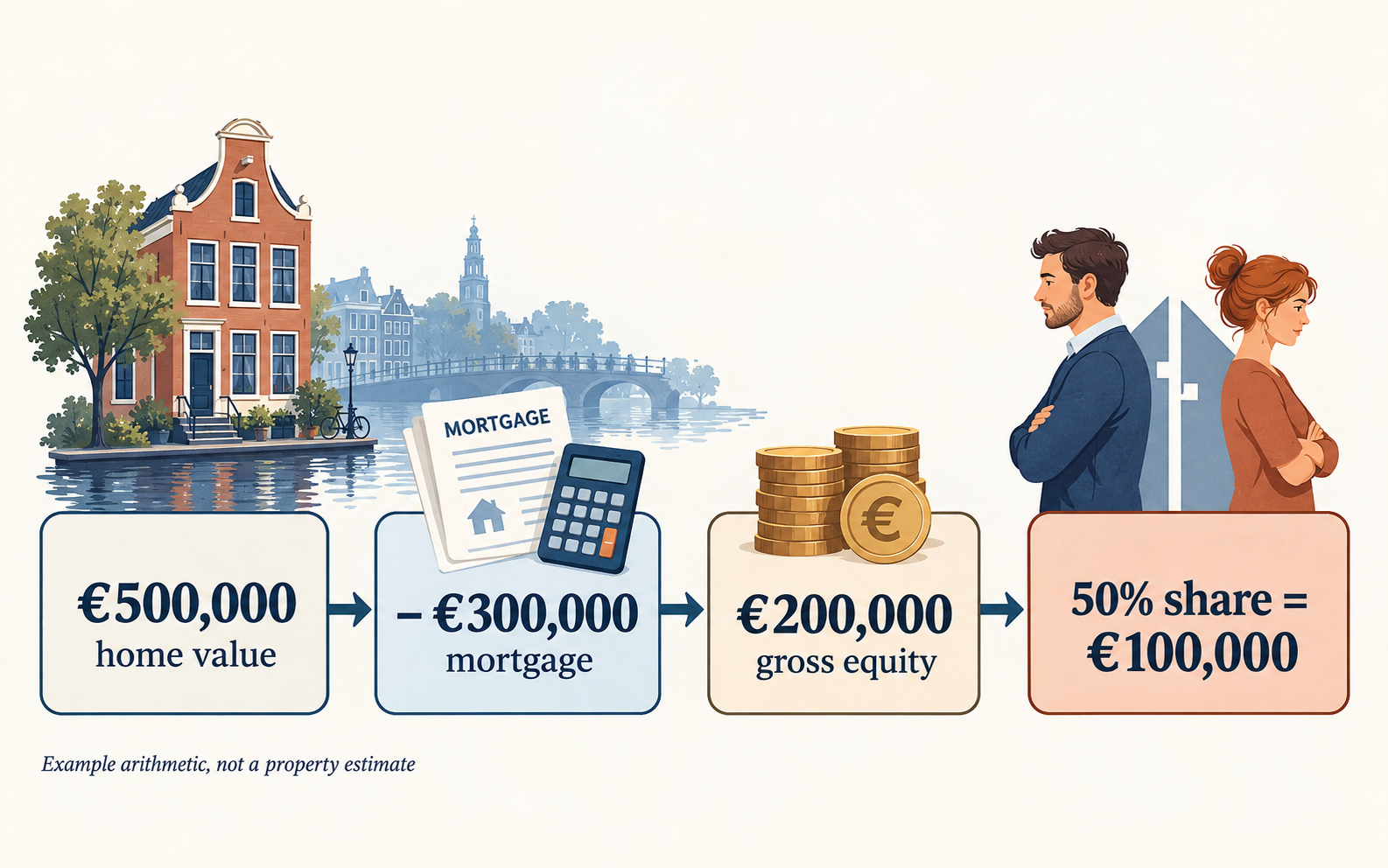
The calculation involves four separate questions:
- Value: what market value does the report state on its valuation date?
- Debt: which mortgage balance and other secured debt belong in the calculation?
- Entitlement: which ownership share and property regime apply?
- Ability to pay: can the person keeping the home finance the transfer and carry the loan?
A lower buyout can have gift or partner-maintenance consequences under the Belastingdienst buyout tax rules. The same source discusses overwaarde and the bijleenregeling. These issues depend on current tax facts. The valuation report provides the property figure and the evidence behind it.
Scenarios and variations
One person keeps the home
In this scenario, the application should include a property value, mortgage balance, ownership position, valuation date and financing check. The person who stays may need to buy the other person’s interest and take responsibility for the loan. A tax adviser can check the effects of the transfer, overwaarde and any lower agreed payment.
Both people sell
The valuation can help both parties understand a likely market position and prepare questions for the sales process. The asking price, final sale price, selling costs, mortgage redemption and settlement of the proceeds are separate items. A market index can show broad direction in Amsterdam, while the report addresses the actual home and date.
The property records include leasehold, a VvE issue or a past renovation
Flag any missing document or disputed fact in the brief. A leasehold term, VvE plan, permit, floor-area record or renovation assumption can affect the valuer’s analysis. Ask the valuer which evidence is needed, and ask your lawyer or notary which document controls the legal decision.
One person has already moved out
Record the departure date and the current living arrangement. The mortgage-interest rule after divorce says the tax result depends on ownership, the loan, who lives in the home and the time since departure. In certain situations, the former home can still qualify as an own home for up to two years. Ask a tax adviser whether that rule applies to your circumstances.
Common mistakes and stalled preparations
Mistake 1: treating 50% as an automatic settlement share
A 50% split applies only when the ownership documents and applicable property regime support it. Check the deed, agreements, private contributions and excluded assets with the relevant adviser.
Mistake 2: using the WOZ value as the private market value
Mistake 3: using an asking price or offer as the report figure
An asking price expresses a selling strategy. An offer expresses one buyer’s proposal. The valuer forms an independent opinion from the property, market evidence and valuation brief. NRVT also warns that a valuer should not be pressured toward a desired outcome.
Mistake 4: leaving the date blank
The Amsterdam index changed from 127.9 in 2024 to 132.4 in 2025, and the Q2 2026 index was 133.5. Those movements show why the date belongs in the brief. They do not justify applying 3.6%, 0.8% or another area percentage to one home.
Mistake 5: mixing value with affordability
Equity shows the relationship between value and debt; it does not show whether one person qualifies for the mortgage after the transfer. Ask the lender or mortgage adviser about that question.
Mistake 6: commissioning two conflicting valuation briefs
Different purposes, dates or user lists can lead to reports that answer different questions. Write down the reason for each instruction before commissioning a second opinion.
If the preparation stalls
If one person will not share a document, record the gap and ask the lawyer or mediator how to request it. If the parties disagree about the valuation date, get that question decided before the inspection. If the report contains a wrong address, date or material assumption, ask the valuer to review the factual error and keep the original report history.
If you still have a question about the property, purpose or date, contact Taxateur Amsterdam with the question and without personal attachments.
After the report
Review checklist
Check these points before using the report in a settlement discussion:
- the address, property type and ownership description;
- the valuation date and market-value definition;
- the purpose and report users;
- the mortgage scope and any excluded debt;
- leasehold, VvE, permits, floor area, renovation and maintenance assumptions;
- the comparable evidence and the explanation of the final figure;
- unanswered questions that belong with a lawyer, notary, tax adviser or lender.
When to revisit the work
Consider a new valuation if the agreed date changes, the home is sold, a major renovation is completed, the mortgage balance changes materially or new property evidence becomes available. The new report should state its purpose and date rather than carry an old figure forward without review.
FAQ about divorce valuation
Is a divorce valuation the same as a WOZ value?
No. A WOZ value is a municipal tax value with its own reference date and process. A private valuation assesses a property’s market value for a defined purpose and date. When a public assessment is compared with a private valuation, WOZ and market value in Amsterdam separate the municipal reference date from the purpose of a private valuation brief.
Is a 50% split always correct?
There is no universal split. Equal division may apply to assets and debts inside the relevant statutory community, while an agreement, ownership deed, gift, inheritance or private asset can change the result. Ask the lawyer or notary to confirm the entitlement before using the arithmetic.
Which valuation date should we choose?
Choose the date that answers the settlement, sale or financing question. A historic date and a current date answer different market questions. Record the reason for the date in the valuation purpose.
Can one person keep the house after the valuation?
Possibly. The transfer, settlement agreement and financing all need to work for both parties. The valuation provides the property figure; the lender and legal or tax advisers assess the rest.
What happens if one person has already left?
Record the departure date, ownership, loan and occupancy facts. The Belastingdienst says mortgage-interest treatment and the former-home rules depend on those facts, including the time since departure. Ask a tax adviser to apply the current rule to the tax year.
Can we use an index to update an old valuation?
An index shows movement for a group of homes in a region. CBS says regional series can fluctuate, and the index does not capture every feature of one home. Ask the valuer whether a new valuation brief or a date-specific analysis is needed.
Agree the purpose, valuation date, report users and ownership documents first. The report gives you a property figure for the stated valuation brief; your lawyer, mediator, lender or tax adviser handles the decision that follows.
Ask a question about preparing this application